Small-Group Strength Training vs. Personal Training: Which Is Right for You?
Your training should fit your goals and the week you actually have. In Scottsdale, that might mean getting a session in before work along Scottsdale Road, between commitments in McCormick Ranch, or around tennis, golf, and plans for a winter ski trip.
If you’re comparing small group training Scottsdale options with personal training, the central question is how much individual support you need—and how that support is delivered.
One-to-one training gives you a coach’s dedicated attention. Small-group strength training shares that attention among participants while potentially retaining individual exercise choices, progression, and feedback. Both can be useful. Neither format guarantees thoughtful coaching simply because of its size.
At proof3, assessment-led small-group strength and endurance training connects coaching with progress tracking. Understanding how that model differs from private training can help you choose a starting point with confidence.
Class Size and Coaching Quality Are Different Questions
A smaller room does not automatically mean a more individualized experience. A private appointment does not automatically mean a well-designed program.
Coaching quality shows up in observable actions: someone asks about your goals, watches you move, explains adjustments, records relevant information, and uses it to guide subsequent sessions.
Class size affects how much attention a coach can distribute. It does not tell you what the coach does with that attention.
During a trial session, notice whether feedback is specific. “Keep going” is encouragement. Explaining a change in stance, checking your understanding, and observing the next set is instruction.
The American College of Sports Medicine’s resistance-training guidance emphasizes individualization and regular participation. It does not establish one commercial training format as universally superior. ACSM resistance-training guidance.
Your decision should reflect the coaching you experience, the support you need, and the routine you can maintain.
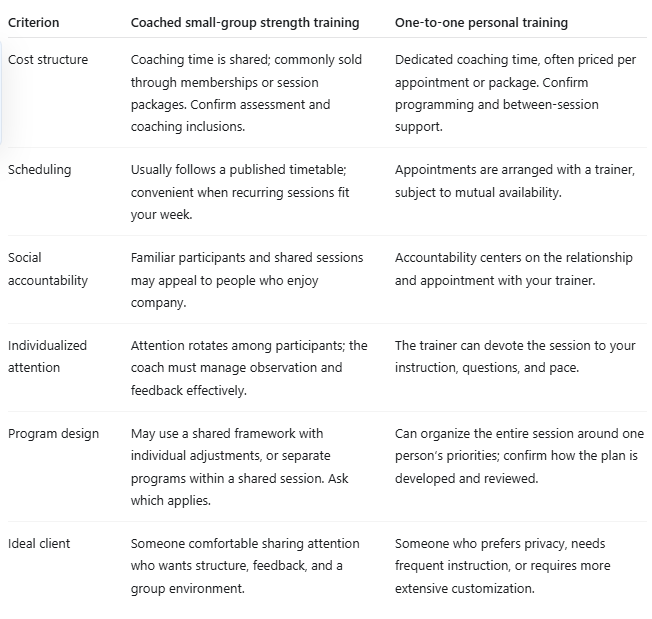
Small-Group Strength Training vs. Personal Training at a Glance
The details vary by provider but use this comparison to guide questions rather than assume every program follows the same model.
Group Fitness and Small-Group Strength Training Are Not Interchangeable
“Group fitness” describes a broad category. It may include cycling, dance, circuits, and strength classes. Many instructors offer thoughtful modifications and excellent teaching.
Coached small-group strength training should be evaluated for something more specific: how strength work develops for each participant over time.
Ask whether the coach knows your previous loads, how exercises are selected, and what determines the next progression. A room with six people following a changing workout is not necessarily an individualized strength program.
Likewise, larger classes can include progression. The label alone settles nothing.
proof3’s FAQ on group training vs. group fitness explains its approach to adjusting group sessions using assessment findings and how someone is doing that day. The useful follow-up is practical: what would those adjustments look like for you?
For a broader comparison of studios, large gyms, and coached environments, see our Gym-choice guide.
How Individualized Programming Can Work in a Group
Individualization does not require every participant to perform a completely different workout. It requires relevant decisions to reflect the person doing the work.
A Shared Framework, Different Starting Points
Consider a session built around squatting, pulling, and endurance work.
One participant might practice a squat to a box. Another might use a goblet squat. Someone with more experience might use a different loading option. Repetitions, resistance, range of motion, and rest can also vary.
These are examples of possible coaching decisions, not prescriptions. Their suitability depends on the individual and the coach’s assessment.
Everyone can share the session’s purpose while working at a different starting point.
Progression That Belongs to You
An individualized approach also needs continuity. Your next session should consider what you previously completed and how it went.
Ask who records that information and whether another coach can access it. You should not have to reconstruct your training history whenever staffing changes.
A shared program with adjusted loads is different from a fully bespoke program. Either may suit you, but the provider should explain which service you are buying.
Enough Attention to Make Adjustments Useful
Customization on paper matters only if the coach can deliver it.
Ask how many people attend, how stations are organized, and what happens when several participants need help simultaneously. Observe whether instructions arrive before you feel rushed into the next exercise.
If you need near-continuous guidance, a group setting may currently ask too much of your independence.
When Small-Group Strength Training May Fit
Small-group coaching can be a strong option when you want a planned session, welcome feedback, and feel comfortable practicing while the coach assists someone else.
It may also appeal if you enjoy seeing familiar people without making every workout a social event. Community can be quiet: someone remembers your name, notices you arrived, and makes room for questions.
Scheduling is another consideration. If you live in Gainey Ranch or McCormick Ranch, check whether the available session fits your actual route along Hayden Road or Via de Ventura. Test the journey at the time you intend to train.
For fall golf or tennis, discuss your playing schedule with the coach. If you have a winter ski trip planned, bring it up early enough to discuss realistic preparation. These activities provide context; they do not automatically require a separate sport-specific program.
Small-group training may fit when your needs can be addressed within the shared structure and you find the environment comfortable enough to return consistently.
When One-to-One Personal Training May Be Preferable
Private training deserves consideration when you want substantial instruction time, prefer privacy, or need the session’s pace and content organized entirely around you.
A beginner who wants repeated explanations may appreciate dedicated attention. So might an experienced trainee working on a particular technical skill or a narrowly defined performance goal.
Scheduling can favor private appointments if class times do not work, although trainer availability still sets limits.
If you have pain, a recent procedure, or a medical condition affecting exercise, the relevant question includes professional scope. A personal trainer is not automatically qualified to provide rehabilitation. Appropriate clinical guidance may be necessary before deciding on either format.
One-to-one training can also be a temporary choice. You might prefer private instruction initially and reassess once you feel more independent.
Explore Personal Training in Scottsdale and ask about qualifications, program design, and the support included.
What an Assessment Adds to the Decision
An assessment can make the format discussion more concrete. Instead of choosing solely from descriptions, you can discuss your goals, training history, movement, current capabilities, and available time.
proof3’s assessment approach includes body-composition information, movement analysis, and strength and power testing. These findings provide material for a coaching conversation about where to begin. Learn about the proof3 Fitness Assessment.
Measurement still requires interpretation. Bioelectrical impedance systems estimate body composition; those estimates are not medical diagnoses. Research comparing an InBody device with DXA found differences between methods, reinforcing the need to interpret results in context. Body-composition comparison study.
Ask how repeat testing is standardized and how results inform decisions. A change in a scan should be considered alongside training records and other relevant information.
An assessment should help answer: How much instruction do you need? Which goals fit the available program? What will be tracked? When will the plan be reviewed?
It cannot promise a particular body change or outcome.
Choosing Small Group Training Scottsdale Adults Can Sustain
Before committing, use this short checklist:
- Attention: Can I get help when I need it?
- Programming: Can the coach explain how my work develops over time?
- Schedule: Does this fit an ordinary week, including travel and meetings?
- Measurement: Will someone explain results and their limitations?
- Comfort: Can I ask questions or request an adjustment without embarrassment?
- Value: Do I understand the full cost and what it includes?
If October workplace wellness discussions are on your agenda, bring the same questions to those conversations. Colleagues may need different formats, and personal assessment information should remain private.
You are choosing a service you can use, with people you trust to guide it.
Frequently Asked Questions
Is Small-Group Strength Training Good for Beginners?
It can be, when onboarding, exercise options, and coach availability match the beginner’s needs. Ask how movements are taught and how much independent practice is expected. If you need frequent assistance throughout a session, private instruction may be a more comfortable starting point. Experience a session before deciding.
Is Small-Group Training Cheaper Than Personal Training?
Sharing coaching time often lowers the per-person session cost, but actual prices and inclusions vary. Compare monthly spending, usable sessions, assessments, programming, and additional fees. A private package with substantial support and a group membership with limited coaching are different services; price alone does not establish value
Why Choose Proof3?
At Proof3, we specialize in creating tailored wellness solutions that fit the unique needs of your organization. Our structured approach ensures that your leadership team receives the support necessary to enhance workplace wellness and foster a culture of health. Join us and experience the difference!
Live Stronger For Longer
Replace guesswork with data-driven strength and endurance training built around how your body actually moves.
No commitment. A coach will call you back — usually the same day.