Yes, women can build muscle after menopause. Not just hold on to what's left, but add to it. Research on postmenopausal women shows it, and so do the body-composition scans we track at proof3 Salt River in Scottsdale.
Maybe you've noticed the shift. The scale barely moves, but your clothes fit differently. Carrying groceries up the stairs takes more effort than it used to. You've been told this is just part of getting older, and the best you can do is slow it down.
We see it differently. Menopause changes the conditions for building muscle. It doesn't close the door. With the right training, enough protein and a way to see what's actually changing, gaining muscle in midlife is a realistic goal.
Here's what the research says, what our members' scans show, and how to put it to work.
What actually changes during menopause
The biggest change is one the scale can't see. During the menopause transition, many women gain fat and lose lean mass at the same time, so body weight can look steady while body composition shifts underneath.
The clearest picture comes from the Study of Women's Health Across the Nation (SWAN), an NIH-funded study that followed women through menopause with DXA body-composition scans. Researchers found that once the transition began, the rate of fat gain doubled and lean mass started to decline. Those changes continued until about two years after the final menstrual period, then leveled off. Body weight, meanwhile, didn't speed up at the start of the transition.
That's why "I haven't gained weight, but something's different" is such a common experience. It's also why we look at body composition rather than weight alone.
Why estrogen matters to muscle
Estrogen isn't only a reproductive hormone. Muscle tissue has estrogen receptors, and NIH-indexed reviews describe several ways estrogen supports muscle:
- Muscle size and quality. A 2019 review in Bone explains that low estrogen reduces strength in two ways: less muscle is preserved, and the remaining muscle produces less force.
- Repair and growth. Estrogen influences satellite cells, the muscle stem cells involved in repair and adaptation. A 2024 review summarizes evidence that these cells may support the muscle growth that comes from resistance training.
- Timing. Another review of estrogen and muscle notes that loss of muscle mass and force in women speeds up relative to men of the same age after menopause.
Hormone therapy is part of this research too, and it's a conversation for you and your clinician. Our focus is the part you can train.
What this means in practice
Lower estrogen makes muscle a little harder to build and a little easier to lose. That raises the bar for the signal you give your body. It doesn't remove the response. Muscle still adapts to challenge at 50, 60 and beyond. The training just needs to be deliberate enough to count.
What our members' scans show
The SWAN data describes what tends to happen without a deliberate plan. Our scans show what can happen with one.
Every proof3 member gets an InBody body-composition scan as part of the proof3 Assessment: at the start of proof30, again at day 30, and as part of each full reassessment after that. Members can also request InBody scans in between. Over time, that builds a record of how skeletal muscle mass changes alongside training.
When we look across those records, a clear pattern shows up. In the words of our founder, Jim Crowell:
"Our data certainly confirms that women can gain skeletal muscle mass after menopause."
We don't share that to promise a number. Every body responds differently, and starting point, training history, consistency, sleep, nutrition and health all play a part. We share it because many women have been told gaining muscle after menopause isn't realistic. Our members' scans say otherwise.
What an InBody scan can and can't tell you
InBody uses bioelectrical impedance to estimate body composition, including skeletal muscle mass and body fat. It's a useful way to establish a starting point and track changes over time, as long as you read it for what it is.
- It's an estimate. Hydration, a recent meal or a hard workout can nudge a reading. That's why we ask members to prepare the same way each time, so repeat scans are comparable.
- Trends beat single readings. One scan is a snapshot. A series of scans, taken under consistent conditions, shows direction.
- It's one view of progress. Muscle mass doesn't tell you how strong or powerful you are. That's why we pair InBody with movement and strength/power testing, and why your coach looks at what you're lifting, too.
- It isn't a bone-density test. If bone health is a concern, a DXA scan ordered by your clinician is the right tool.
How to build muscle after 40: what the research supports
Building muscle after menopause comes down to a few fundamentals done consistently: challenging resistance training, enough of it, some speed in the work, enough protein, and time.
1. Lift with real challenge, and progress it
Muscle grows when the work asks more of it than it's used to. In midlife, that challenge matters more, not less. Light "toning" work that never gets harder won't send much of a signal.
The good news: postmenopausal women respond. A 2024 network meta-analysis of 151 randomized trials in older adults found that even a lower weekly volume of resistance training improved lean mass, muscle size and physical function. Higher volumes produced bigger strength gains. Research focused specifically on postmenopausal and older women points the same way: both lower- and higher-volume programs build muscle, and more volume tends to build more.
In practice, that means working the major muscle groups at least twice a week, with resistance that feels genuinely challenging by the last few reps, and a coach who knows when to add more. Our article on progressive overload explains how we make that call.
2. Train power, not just strength
Power is strength plus speed: getting up off the floor, catching yourself on a stumble, taking the stairs two at a time. It tends to decline faster than strength with age.
A 2025 study in Mayo Clinic Proceedings followed 3,889 adults aged 46 to 75 for about a decade. Women with the lowest relative muscle power had a substantially higher mortality risk than women with the highest. This is an observational association, not proof that power training extends life, and it used different tests from ours. It's still a strong reason to include controlled, purposeful speed in training, not just slow lifts.
3. Eat enough protein to support the work
Training is the signal. Protein supplies the building material. A 2018 meta-analysis of 49 trials found that adding protein improved muscle gains from resistance training, with benefits leveling off around 1.6 grams per kilogram of body weight per day. The researchers also found the effect was smaller in older adults, which is one reason consistent intake matters more with age.
That figure comes from research on healthy adults, not a prescription. Your needs depend on your health, kidney function, medications and goals, so talk with your health-care team before making big changes. proof30 includes a one-to-one lifestyle and nutrition planning conversation where we can talk through how your eating supports your training.
Protein matters for bone, too. The NIH's National Institute of Arthritis and Musculoskeletal and Skin Diseases (NIAMS) lists excessive dieting and poor protein intake among the factors that may increase the risk of bone loss.
4. Give it time and keep showing up
Muscle is built over months, not weeks. Strength often improves first, as your nervous system learns the movements. Changes in muscle mass take longer and show up more clearly across a series of scans than from one to the next.
Consistency beats intensity here. Two or three sessions you actually attend, week after week, will do more than an ambitious plan you abandon in March. Our article on how often to strength train goes deeper on building a schedule you can keep.
Muscle and bone: training that supports both
The same training that builds muscle also loads bone, and that matters after menopause. According to NIAMS, osteoporosis is the major cause of fractures in postmenopausal women, and for many women the disease begins to develop a year or two before menopause. Low estrogen after menopause is one of the listed risk factors. Staying physically active with weight-bearing exercise is one of the steps NIAMS recommends.
For years, women with low bone density were steered toward gentle exercise only. The LIFTMOR trial tested that assumption. Researchers randomly assigned 101 postmenopausal women with low bone mass, average age 65, to either a supervised high-intensity resistance and impact program or a home-based low-intensity program.
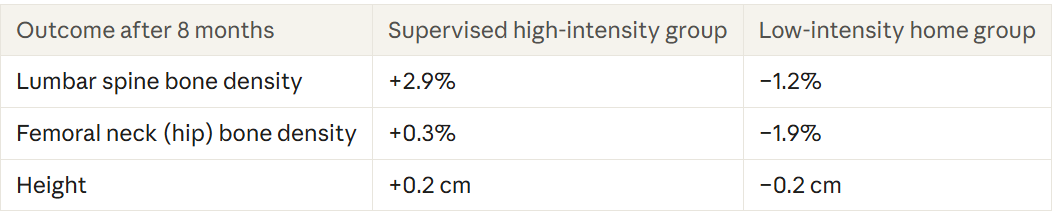
The supervised group also improved on every functional test, and only one minor adverse event was reported. (source)
Two caveats matter. These results apply to that specific, closely supervised program and that group of women. They don't automatically transfer to any gym's classes, including ours. And if you have osteopenia or osteoporosis, talk with your care team about what training is appropriate for you, then bring that guidance to your coach.
What the trial does show is important: with the right supervision and progression, heavier training isn't automatically off-limits for postmenopausal women with low bone mass.
Muscle and metabolic health
Muscle isn't only about strength. It's one of the body's most active tissues, and resistance training appears to help with the metabolic shifts many women notice after menopause.
A 2024 meta-analysis of 20 randomized trials in postmenopausal and older women with overweight or obesity found that resistance training improved body fat, metabolic risk markers and inflammation compared with no training. Higher-volume programs produced larger improvements in blood glucose and C-reactive protein, a marker of inflammation. The authors rated the certainty of the evidence as low to very low, so treat these as encouraging findings rather than settled numbers.
Put that next to the SWAN findings and the picture is consistent. Menopause tends to shift body composition toward more fat and less lean mass. Resistance training pushes in the other direction. It won't override every hormonal change, and it isn't a treatment for any condition. It is one of the most practical levers you have.
If weight loss is also a goal, strength training can help you hold on to muscle while you lose fat. Our article on strength training and fat loss covers that in more detail.
How we approach it at proof3 Salt River
We built proof3 around a simple idea: train with purpose, measure what changes, and adjust. For women building muscle after menopause, that looks like this.
- Start with a baseline. Your proof3 Assessment brings together body-composition, movement and strength/power information. InBody estimates your skeletal muscle mass and body fat. Our computer-vision movement assessment gives coaches information about how you move. Proteus testing shows how your power compares with reference data. Your coach walks you through the results in plain language.
- Get an individualized plan. We use what we learn, plus your goals and any guidance from your health-care team, to decide where you start: which exercises, what resistance, and what to focus on first.
- Train with a coach in a small group. Our signature 30/30 session is 60 minutes: 30 minutes of strength and 30 minutes of endurance. Coaches adjust load and intensity for you within the group, so you're challenged at your level rather than following everyone else's weights.
- Reassess and adjust. proof30, our introductory experience, includes coached assessments on day 0 and day 30. After that, full reassessments typically happen about every six months, and you can request InBody scans in between. Each round shows what's changing and helps your coach decide what to change next.
That loop of training, measuring and adjusting is how we turn "I think I'm getting stronger" into something you can see. It's also how we've seen that women in our gym can build muscle after menopause, not just hold on to it.
Drop by and see us at our Salt River studio, call us at (520) 524-6983 or send a message to info@proof3.com. We'd love to hear what you're working toward.
Frequently asked questions
Can women really gain muscle after menopause? Yes. Randomized trials in postmenopausal women show gains in lean mass and muscle size with resistance training, and our members' InBody scans show women gaining skeletal muscle mass after menopause. How much any one person gains varies.
Is it too late to start strength training at 55, 60 or 65? No. The LIFTMOR participants averaged 65 years old, and research in older adults shows benefits from resistance training well into later life. Start where you are, with instruction and resistance that fits your current ability.
How often should I strength train after menopause? General CDC guidance is muscle-strengthening activity for all major muscle groups at least two days a week. Your coach can help you decide whether more fits your goals and recovery.
Will lifting heavier weights make me bulky? Building muscle is gradual, especially after menopause. Most women notice they feel stronger, move more easily and see changes in how their clothes fit. Your coach sets the resistance with your goals in mind.
How will I know if I'm gaining muscle? Track what you lift and repeat body-composition scans under consistent conditions. At proof3, InBody scans at your assessments, plus scans you can request in between, show how your estimated skeletal muscle mass is trending alongside your strength and power results.
Do I need a bone-density scan before I start? That's a question for your clinician, especially if you have risk factors for osteoporosis. Our assessment doesn't replace a medical bone-density test, and we use relevant guidance from your care team to shape your training.
Related reading
- Strength Training During Menopause in Scottsdale
- Strength Training for Midlife Women: Looking Beyond the Scale
- Your First Fitness Assessment at proof3 Scottsdale
- How to Tell Whether Your Strength Training Is Working
Sources
- Greendale GA, et al. Changes in body composition and weight during the menopause transition. JCI Insight. 2019. (SWAN)
- Collins BC, et al. Aging of the musculoskeletal system: how the loss of estrogen impacts muscle strength. Bone. 2019.
- Sex hormones and satellite cell regulation in women. Review, 2024.
- Review of estrogen, hormone therapy and skeletal muscle in older women (PMC4261347). Review.
- Effects of resistance training volume on physical function, lean body mass and lower-body muscle hypertrophy and strength in older adults: network meta-analysis of 151 randomised trials. 2024.
- Araújo CGS, et al. Muscle power versus strength as a predictor of mortality in middle-aged and older men and women. Mayo Clinic Proceedings. 2025.
- Morton RW, et al. A systematic review, meta-analysis and meta-regression of the effect of protein supplementation on resistance training-induced gains in muscle mass and strength in healthy adults. British Journal of Sports Medicine. 2018.
- Watson SL, et al. High-intensity resistance and impact training improves bone mineral density and physical function in postmenopausal women with osteopenia and osteoporosis: the LIFTMOR randomized controlled trial. Journal of Bone and Mineral Research. 2018.
- Effect of resistance training volume on body adiposity, metabolic risk and inflammation in postmenopausal and older females. Systematic review and meta-analysis.
- National Institute of Arthritis and Musculoskeletal and Skin Diseases. Osteoporosis.
- Centers for Disease Control and Prevention. Adult activity: an overview.