“Am I going to lose muscle?”
We hear that question from people taking GLP-1 medications, people thinking about taking them, and people who would rather lose weight without medication. It is a reasonable concern. You want less body fat. You would probably like your clothes to fit differently. You also want to keep your strength.
Weight loss can include muscle loss whether or not you take a GLP-1. The amount varies, and a loss of “lean mass” on a scan is not the same as a direct measurement of muscle lost. That is why we care about how you lose weight, what you eat, and whether you strength train along the way.
At proof3, we went looking at the research because this comes up with real people in our gym. One tirzepatide study gave us a useful reminder: the people losing weight without the drug lost lean mass, too.
That changes the conversation quite a bit.
What happened in the group that did not take tirzepatide
The SURMOUNT-1 body-composition substudy compared people taking tirzepatide with people taking a placebo. Tirzepatide is the medication in Mounjaro and Zepbound. The substudy included 160 adults with overweight or obesity, without diabetes, who had body-composition scans available for the analysis.
Both groups received guidance to reduce calorie intake and increase physical activity. There was no standardized resistance-training program. Researchers used DXA, a type of scan that estimates body composition, to look at changes over 72 weeks.
Here is what they found:
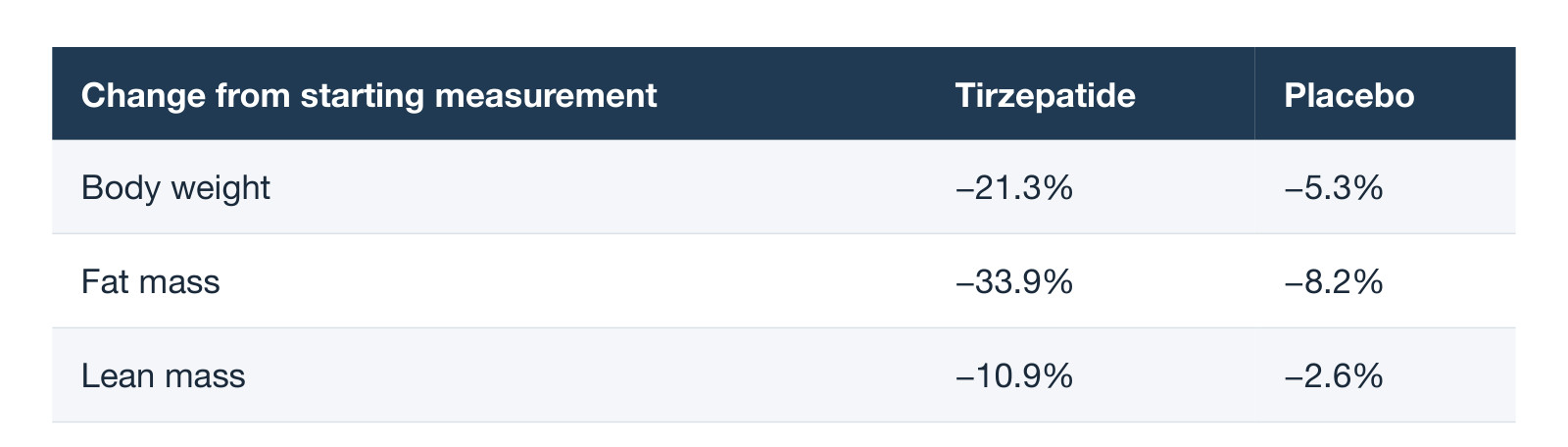
Each percentage describes the change in that particular measurement. A 10.9% reduction in lean mass is a different calculation from the percentage of total weight loss that came from lean mass. Read the published SURMOUNT-1 substudy.
The placebo group lost weight, fat and lean mass. So did the tirzepatide group, in larger amounts.
For us, that is the first thing worth understanding. Taking medication was not a requirement for lean-mass loss to occur. Avoiding medication did not automatically protect the people in the comparison group from it.
This is also why we would be careful with a headline that says a particular drug “costs you muscle.” It can leave you thinking the alternative is weight loss with no muscle-related concerns at all. The comparison here does not support that assumption.
Similar proportions can still mean more pounds lost
In this study, roughly three-quarters of the weight lost was fat and one-quarter was lean mass in both groups. The newsletter rounded the split to 74% fat and 26% lean mass for tirzepatide, compared with 75% and 25% for placebo.
Those proportions were close. The total amounts were different.
Here is an illustration, using round numbers rather than individual study results. If someone loses 20 pounds and a quarter of that is lean mass, that is 5 pounds. If someone loses 40 pounds with the same split, that is 10 pounds.
The same proportion does not make those two changes interchangeable. You would want to know the person's starting point, how their strength changed, and whether the weight loss improved their health.
It also matters what the percentage refers to. “A quarter of the weight lost was lean mass” does not mean “a quarter of the person's original muscle disappeared.” Those statements describe very different things. The study did not measure the second one.
We would not use the group average to tell you exactly what will happen to your body. We would use it to explain why a plan for weight loss should include a plan for maintaining strength.
That applies whether your appetite changes because of medication or you are deliberately eating less without it.
What this study cannot tell you about your muscles
Lean mass includes muscle, water, organs and other non-fat soft tissues. When that measurement changes, we cannot assign every pound of the change to muscle.
The substudy also did not directly test muscle strength or physical function. It cannot tell us whether a participant could carry more, climb stairs more easily, or get through a workout with less difficulty afterward. Nor can it tell us how a structured lifting program would have changed the results.
These are useful limits to keep in mind. They keep us from making the finding either scarier or more reassuring than it deserves to be.
“You will definitely lose this much muscle” goes too far. So does “the proportions were similar, therefore there is nothing to worry about.”
The study gives us information about body composition in a particular group, under particular conditions. It gives us reasons to pay attention. It does not give us a prediction for every person taking every medication.
There is another consideration: Eli Lilly, the manufacturer, funded the research, and several authors were company employees. We want readers to know that. We still look at the methods and findings, while keeping the financial relationships visible.
Our approach at proof3 is to follow the data and ask what it can reasonably support. In this case, it supports a broader view of weight loss than the number on the scale.
The useful question is how you plan to lose weight
For someone carrying substantial excess body fat, losing weight can be an important part of medical care. Being concerned about muscle does not make that goal less legitimate.
We also understand that appearance matters. People want to feel better in their clothes. Health and appearance both come up in the conversations we have, and there is no need to pretend otherwise.
What we want is for those goals to sit alongside a practical effort to maintain or improve physical capability. You should be thinking about the body you want to live in after the weight loss, too.
That brings us back to a few things you can discuss with your coach and care team:
- Strength training: What resistance exercise will you do consistently, and how will the work progress?
- Food: Are you eating enough overall and getting enough protein for your individual needs?
- Starting measurements: What do you know about your body composition and strength now?
- Follow-up: When will you review the changes, and who will help you interpret them?
There is evidence beyond medication trials for taking resistance exercise seriously during weight loss. A 2025 research review found benefits from adding resistance exercise to dietary weight loss. It supports including training, without promising that every person will keep every pound of muscle. Read the research review.
Notice that the plan is relevant to both groups: people taking a medication and people who are not.
Keep the goal bigger than a lower weigh-in
Suppose your weight is dropping and you are pleased with that. It is still worth asking whether you can manage your usual exercises, whether meals are becoming difficult, and whether you feel capable outside the gym.
Those questions do not cancel out the progress. They help you understand it.
One difficult workout is not proof that you have lost muscle. One body scan is not a complete account of your health. A pattern of falling performance, poor intake or measurements that concern you deserves a conversation with the people helping you.
If you have already started losing weight, you have not missed your chance to establish a useful starting point. Record where you are now. You cannot recreate an earlier scan that never happened, but you can make the next few months easier to understand.
We want people to build and maintain muscle as early as they reasonably can, while improving their health. For some people, that will happen alongside medication. For others, it will happen without it. Either way, the training and nutrition questions remain worth answering.
At proof3 in Scottsdale, our body-composition, movement and power assessment helps connect your starting measurements with a training plan. Bring your goals and any exercise guidance from your clinician. We will help you work out what to pay attention to in the gym.
Your prescribing clinician handles medication decisions. Our contribution is helping you get stronger and understand how your training is going.
Whether or not a GLP-1 is part of your plan, your strength deserves attention from the beginning.
Live Stronger For Longer
Replace guesswork with data-driven strength and endurance training built around how your body actually moves.
No commitment. A coach will call you back — usually the same day.