Golf practice develops the skill of playing golf. Strength training develops physical capacities that may support that skill, such as producing force, moving with control and tolerating a demanding week of practice and rounds.
For recreational golfers, the aim is to connect gym work with a clear need rather than collect exercises that resemble a swing. A stronger body does not automatically produce a lower handicap, and no general program can promise a particular increase in driving distance.
What does research suggest?
A systematic review of strength-and-conditioning interventions in golfers examined measures such as clubhead speed, ball speed and distance. The literature supports potential improvements in selected performance measures, while programs and participants vary.
Those findings do not establish that every gym routine improves every golfer's scoring. Clubhead speed, accuracy, course management and putting are different outcomes. A physical-training study should not be read as a guarantee of better scores.
Identify the physical question you want to address
Tell your coach about your playing schedule, current training, fatigue during rounds and any symptoms or exercise restrictions. Ask whether the priority is general strength, endurance, movement capacity or a more specific performance quality.
If pain affects your swing or walking, seek an appropriate clinical assessment. A movement screen cannot diagnose why your back or shoulder hurts, and loading a painful pattern is not a substitute for that evaluation.
Build general strength before adding complexity
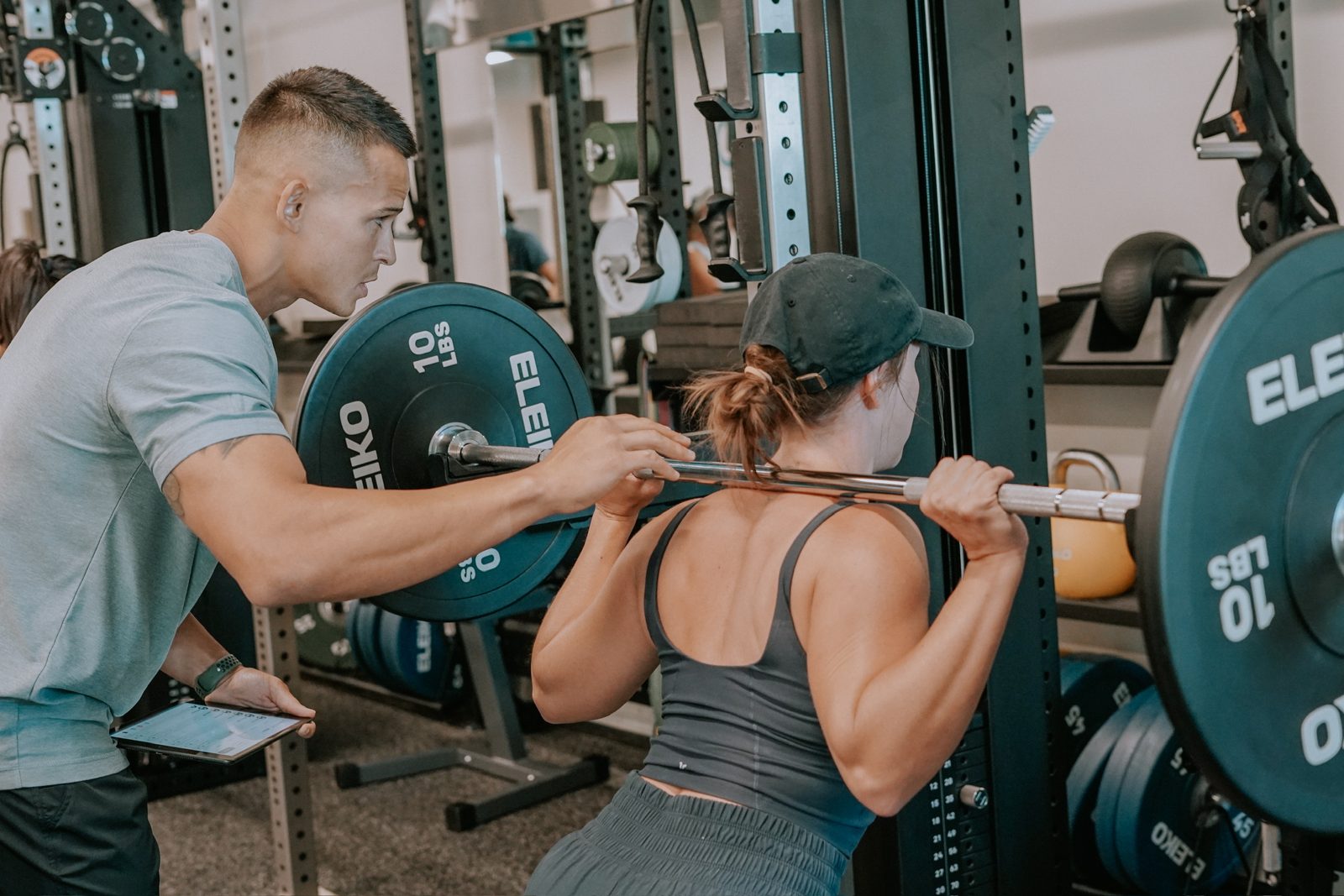
A coach may use suitable versions of squatting, hinging, pushing, pulling and carrying to develop general capacity. The exercise choice and resistance should reflect your experience and control. A program does not need to imitate a golf swing to provide useful strength work.
The article on progressive overload explains how the challenge can change over time. Practice, manageable effort and a clear reason for progression matter more than choosing the most athletic-looking variation.
Treat rotational power as a coached skill
Rotational exercises may be part of a plan, but they need appropriate setup, space and instruction. A medicine-ball throw, cable movement and loaded twist are not interchangeable, and more speed or resistance is not automatically better.
Ask what the exercise is intended to develop and how the coach will judge a useful repetition. People new to lifting may first need more familiar strength work. High-speed drills should be introduced according to readiness and goals rather than prescribed to every golfer.
Use mobility work for a defined purpose
If a position is difficult, ask what movement is limited and how it affects the task. A coach can explore appropriate exercise options; a clinician addresses pain or a suspected injury. Avoid forcing range of motion to match another golfer's appearance.
Greater flexibility alone does not guarantee a better swing or prevent injury. Coordinate physical training with your golf instructor when technique and movement capacity interact. Keep their different roles clear.
Plan gym work around the round
Look at the whole week, including practice, walking the course, travel and tournaments. Introducing a demanding new leg session immediately before a long round may make the week harder to manage. Discuss how to place more challenging work and when a lighter session makes sense.
Our guide to planning recovery between sessions provides context for golfers balancing several activities. Age alone does not determine the schedule.
Track the gym and the course separately
Use comparable exercise records to assess strength development. If you measure clubhead speed or distance, keep the testing setup as consistent as possible and discuss interpretation with your golf professional. Improvement in one measure does not prove the cause of a change in another.
Do I need three strength sessions a week?
Not as a universal golf rule. Your starting experience, playing schedule and recovery should shape the plan.
Can proof3 replace golf lessons?
No. proof3 provides fitness coaching. Explore the proof3 Assessment to discuss a physical starting point while keeping sport technique with an appropriate golf instructor.