How to Support Employee Wellness Without Overstepping
Managers shape the day-to-day experience of work more thanany wellness policy does. They decide whether someone can step away for amidday workout, whether meetings run through lunch, and whether people feelcomfortable using the benefits on offer. A well-designed wellness program canstill fail if managers ignore it, or if they push it so hard it feelsmandatory.
This playbook gives managers a practical framework: what todo, what to avoid, what to say, how to handle scheduling and coverage, andwhere to send questions you should not answer yourself.
The Three Principles
Every recommendation in this playbook comes back to threeideas.
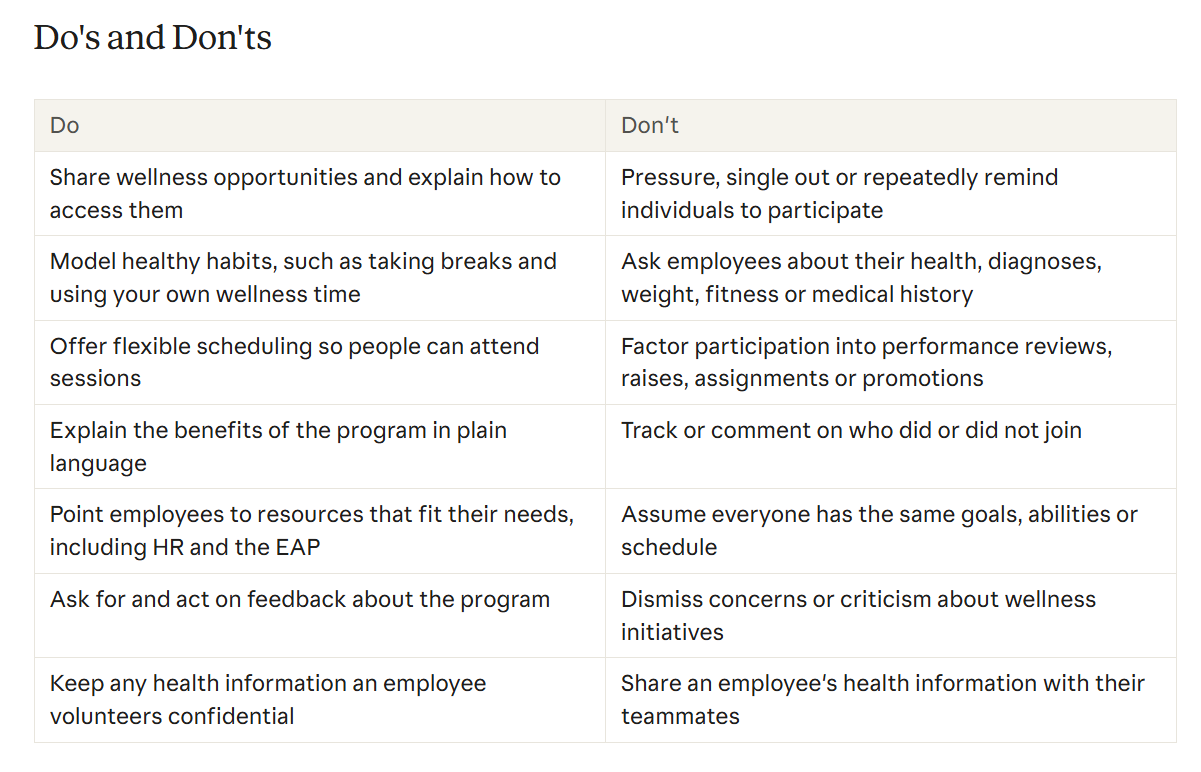
1. Participation is voluntary. Employees choosewhether to take part, and that choice never affects how they are evaluated,assigned work or treated.
2. Health information is private. Managers make roomfor wellness. They do not collect, request or share details about anyone'shealth.
3. Access is the manager's job. Your most valuablecontribution is removing obstacles such as schedule conflicts, coverage gapsand meeting overload so people who want to participate can.
Sample Manager Messages
Use these as starting points and adapt them to your voiceand team. Each one invites participation without implying an expectation.
Announcing a program or event
"Our new wellness program kicks off next week, includingon-site strength sessions and assessments. It's completely optional. If itinterests you, details are in the HR portal, and I'm happy to work around yourschedule so you can attend."
Making time available
"If you'd like to join a wellness session during workhours, let me know and we'll plan coverage. You don't need to explain why. Justgive me a heads-up so we can adjust the schedule."
Modeling the behavior
"I'm blocking 45 minutes on Tuesdays and Thursdays for aworkout and will be offline then. I'd encourage everyone to protect time forwhatever helps you recharge."
Pointing to resources
"Our benefits include a range of wellness resources, fromfitness programming to the Employee Assistance Program. HR can walk you throughthe options confidentially if you'd like to explore what fits you."
Asking for feedback
"We want this program to be useful, not just anotherinitiative. What's working, what isn't and what would make it easier to takepart? You can tell me directly or use the anonymous survey."
Shift Coverage and Scheduling
For many teams, especially shift-based or customer-facingones, the biggest barrier to participation is simply time. Plan for it.
• Build a coverage rotation. Pair team members soeach person's session time is covered by a colleague, and rotate so the burdenis shared evenly.
• Offer multiple time slots. Early, midday andend-of-shift options help people with caregiving responsibilities, commutes ordifferent energy patterns.
• Treat wellness time like any other scheduled block.Put sessions on the team calendar and protect them unless there is a genuineoperational emergency.
• Be consistent. Apply the same flexibility toeveryone who asks. Approving time for some employees but not others creates afairness problem.
• Plan around peak periods. If a busy season makessessions difficult, say so upfront and suggest alternatives rather than quietlyletting access disappear.
Meeting Culture
Meeting habits have a large effect on whether people havetime and energy to take care of themselves.
• Protect breaks. Default to 25- or 50-minutemeetings so people have time to move, eat or reset between calls.
• Keep lunch free. Avoid scheduling recurringmeetings over the midday hour.
• Consider meeting-free blocks. A team-wide blockof time without meetings, such as one afternoon a week, gives people room forfocused work and wellness activities.
• Offer walking meetings as an option, not a rule.They work well for one-on-ones, but always give the other person a seatedalternative.
• Keep wellness check-ins general. In one-on-ones,ask open questions such as "Is your workload sustainable?" or"Is there anything getting in the way of using our wellnessresources?" Let the employee decide how much to share.
If an Employee Shares Health Information
Employees sometimes volunteer personal health details. Whenthat happens:
1. Listen and thank them for trusting you. You donot need to give advice.
2. Keep it confidential. Do not share theinformation with teammates or note it in performance documents.
3. Focus on work and support. Ask what would help,such as a schedule adjustment, and refer them to HR for anything involvingaccommodations or leave.
4. Don't diagnose or recommend treatment. Pointthem to qualified resources such as their healthcare provider or the EAP.
Escalation Path for Wellness Questions
Managers should handle scheduling and general encouragement.Anything involving eligibility, benefits, privacy, accommodations or personalhealth belongs with HR or a qualified professional.
1. Manager: Scheduling, coverage, general programinformation and directing employees to resources.
2. HR: Questions about eligibility, incentives,benefits, privacy, workplace accommodations or leave. Employees can contact HRdirectly at any time without going through their manager first.
3. Employee Assistance Program (EAP): Confidentialsupport for stress, mental health, family or financial concerns, if yourorganization offers one.
4. Emergencies: If an employee is in immediatedanger or a medical emergency, call 911. If someone is in emotional crisis,they can call or text 988 to reach the Suicide & Crisis Lifeline.
When you are unsure whether something is your question toanswer, refer it to HR. That protects the employee and you.
Quick Reference
• Encourage, don't pressure.
• Make time, don't make it mandatory.
• Point to resources, don't ask about health.
• Keep participation separate from performance.
• Ask for feedback and act on it.
Bring Wellness to Your Organization
Managers create the conditions for wellness. The rightprogram gives employees something worth making time for. If you are looking foran assessment-led corporate fitness option in Scottsdale, Proof3 builds personalized, coach-guidedstrength programs designed around your team's schedules and goals.
This playbook offers general guidance and is not legaladvice. Wellness program rules on incentives, health information andaccommodations vary. Review your program with HR and legal counsel.
Why Choose Proof3?
At Proof3, we specialize in creating tailored wellness solutions that fit the unique needs of your organization. Our structured approach ensures that your leadership team receives the support necessary to enhance workplace wellness and foster a culture of health. Join us and experience the difference!