Body Fat Percentage Explained: What the Number Can, and Cannot, Tell You
Body fat percentage is one of the most useful measures of body composition, and one of the most misunderstood. A single reading can shift by several points depending on the method used, the time of day and even how much water you drank. Used correctly, though, it gives a far more meaningful picture of progress than the scale alone.
This guide explains what body fat percentage measures, how the most common methods compare, why trends matter more than any single number, and how to measure in a way that produces data you can trust. It is written for busy adults in Scottsdale who want to track changes in body composition without being misled by noise.
What Body Fat Percentage Measures
Body fat percentage is the share of your total body weight that comes from fat mass. Everything else, including muscle, bone, organs and water, is grouped as fat-free mass.
This distinction is why body fat percentage is more informative than body weight or BMI. Two people can weigh the same and have the same BMI while carrying very different amounts of muscle and fat. Someone who starts strength training may see the scale stay flat while their body fat percentage falls, because they are gaining muscle and losing fat at the same time.
Some body fat is essential. It stores energy, insulates organs and supports hormone production. The goal is a healthy range for your age, sex and goals, not the lowest possible number.
General Reference Ranges
The American Council on Exercise (ACE) publishes widely used general categories:
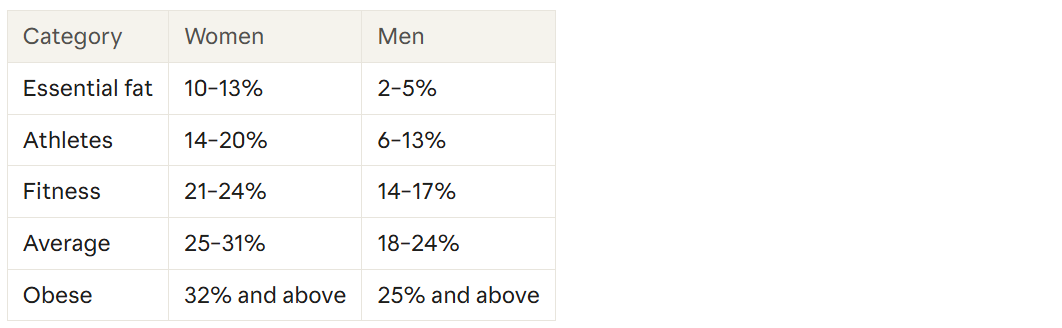
Treat these as broad guidelines rather than targets. Healthy ranges shift with age, and different measurement methods can place the same person in different categories.
How Body Fat Is Measured
No practical method measures body fat directly. Every method estimates it from something else, such as tissue density, skinfold thickness or electrical resistance, and each one carries its own error.
DEXA (dual-energy X-ray absorptiometry). DEXA uses low-dose X-rays to separate fat, lean tissue and bone, and shows where fat is distributed across the body. It is one of the most precise methods available and is often used as a reference in research. Results can still vary between scanner models and with hydration or recent meals, so repeat scans should be done on the same machine under the same conditions. It costs more and is less accessible than other options.
Bioelectrical impedance analysis (BIA). BIA sends a small, painless electrical current through the body. Because lean tissue holds more water than fat, it conducts electricity more easily, and the device uses that resistance to estimate body composition. Clinical-grade multi-frequency devices are considerably more reliable than consumer bathroom scales. All BIA results are sensitive to hydration, recent food and fluid intake, exercise and skin temperature (Kyle et al., 2004).
Skinfold calipers. A trained assessor measures the thickness of skin and fat at standard sites and enters the values into an equation. The method is inexpensive and can be reliable for tracking change, but accuracy depends heavily on the assessor's skill and on using an equation validated for the person's age, sex and population.
Other methods. Air displacement plethysmography (Bod Pod) and hydrostatic (underwater) weighing estimate body fat from body density. Both are accurate when performed correctly but are mainly available in clinical, university or specialty settings.
The key point: results from different methods are not interchangeable. A reading of 22% on a DEXA scan and 26% on a bathroom scale may describe the same body. Pick one method and stay with it.
What the Number Cannot Tell You
Body fat percentage is a useful indicator, but it has clear limits.
- Where fat is stored. Fat stored around the abdominal organs (visceral fat) is more strongly linked to cardiometabolic risk than fat stored under the skin (Neeland et al., 2019). Two people with the same body fat percentage can have very different health profiles. DEXA and waist circumference provide useful additional context.
- Metabolic health. Blood pressure, blood sugar and cholesterol are measured separately and are not reflected in a body composition reading.
- Fitness and function. Strength, cardiovascular fitness and mobility predict long-term health and independence in their own right, and they improve with training regardless of what the body fat number does.
- Your worth or effort. Body composition changes slowly and is influenced by genetics, age, sleep and stress. A number that moves slowly is not a sign of failure.
Why Trends Matter More Than Single Readings
Every measurement includes some error. Even under good conditions, a single reading can differ from your true value by a percentage point or more, and with consumer devices the variation is often larger. Meanwhile, real changes in body fat happen gradually, often over weeks or months.
That means a change of one point between two measurements may be nothing more than measurement noise. Dehydration after a hard workout or a hot day, a salty meal, or alcohol the night before can all shift a BIA reading without any real change in fat mass.
A trend built from several measurements taken consistently over time is far more reliable. If your readings move in the same direction across two or three months, the change is very likely real.
How to Measure Consistently
To make your measurements comparable, control the variables you can. For BIA in particular, these guidelines are commonly recommended:
- Use the same device and method every time. Never compare a scan from one machine with a reading from another.
- Measure at the same time of day, ideally in the morning after using the bathroom.
- Avoid eating or drinking for about 3 to 4 hours beforehand, or measure before breakfast.
- Skip strenuous exercise for about 12 hours before the measurement.
- Avoid alcohol for 24 to 48 hours beforehand.
- Keep your routine consistent in the days leading up to a measurement, including hydration and sleep.
- Space measurements out. Every 4 to 8 weeks is usually enough to see meaningful change. Measuring more often tends to track noise, not progress.
Putting It Together
Body fat percentage is most valuable as one data point within a broader picture. Combine it with measures such as strength progress, waist circumference, energy levels and how your clothes fit to get a full view of your progress.
The most reliable approach is simple: choose one method, measure under the same conditions, focus on the trend over several months and set goals based on how you want to feel and function, not just a number.
Track Your Progress With Proof3
At Proof3, we use assessment-led, goal-based progress tracking with consistent protocols, clear explanations and no judgment. If you'd like an accurate baseline and a plan built around your goals, schedule an assessment with our team in Scottsdale.
References
- American Council on Exercise. Percent body fat norms for men and women.
- Kyle, U. G., et al. (2004). Bioelectrical impedance analysis, part II: Utilization in clinical practice. Clinical Nutrition, 23(6), 1430–1453.
- Neeland, I. J., et al. (2019). Visceral and ectopic fat, atherosclerosis, and cardiometabolic disease: A position statement. The Lancet Diabetes & Endocrinology, 7(9), 715–725.
This article is for general educational purposes and is not medical advice. Talk with your healthcare provider about what body composition targets are right for you.
Why Choose Proof3?
At Proof3, we specialize in creating tailored wellness solutions that fit the unique needs of your organization. Our structured approach ensures that your leadership team receives the support necessary to enhance workplace wellness and foster a culture of health. Join us and experience the difference!