You do not need to know your way around a weight room before you start strength training. You need someone to explain the exercises, help you choose a starting level and pay attention as you learn.
If you are looking for strength training for beginners in Scottsdale, start by asking what your first visit will actually involve. Knowing who will help, how the exercises will be adjusted and what happens next can make walking through the door feel more manageable.
Start with what you want strength to help you do
Perhaps you want to carry luggage more comfortably, feel stronger on the tennis court or get off the floor with less effort. You may already walk or cycle regularly and still be completely new to lifting weights.
Tell your coach about those goals, your previous experience and the activities already in your week. Mention relevant health conditions, pain, injuries and any exercise guidance from your care team. This conversation helps the coach choose an appropriate starting point.
You do not have to get fit on your own before asking for instruction.
What should happen before your first group session?
At proof3 Salt River, we start with the proof3 Fitness Assessment. It brings together body-composition estimates, movement observations and strength and power testing. Your coach explains how that information will guide your training.
An assessment should lead to practical decisions: which exercise versions to introduce, where to begin and what to track. It is not medical clearance or a guarantee against injury.
Our introductory experience also includes a private, 60-minute session with a coach before you join the group. That gives you time to discuss your results, learn the movements and ask questions about equipment without trying to follow an unfamiliar room.
Learn the setup before adding more weight
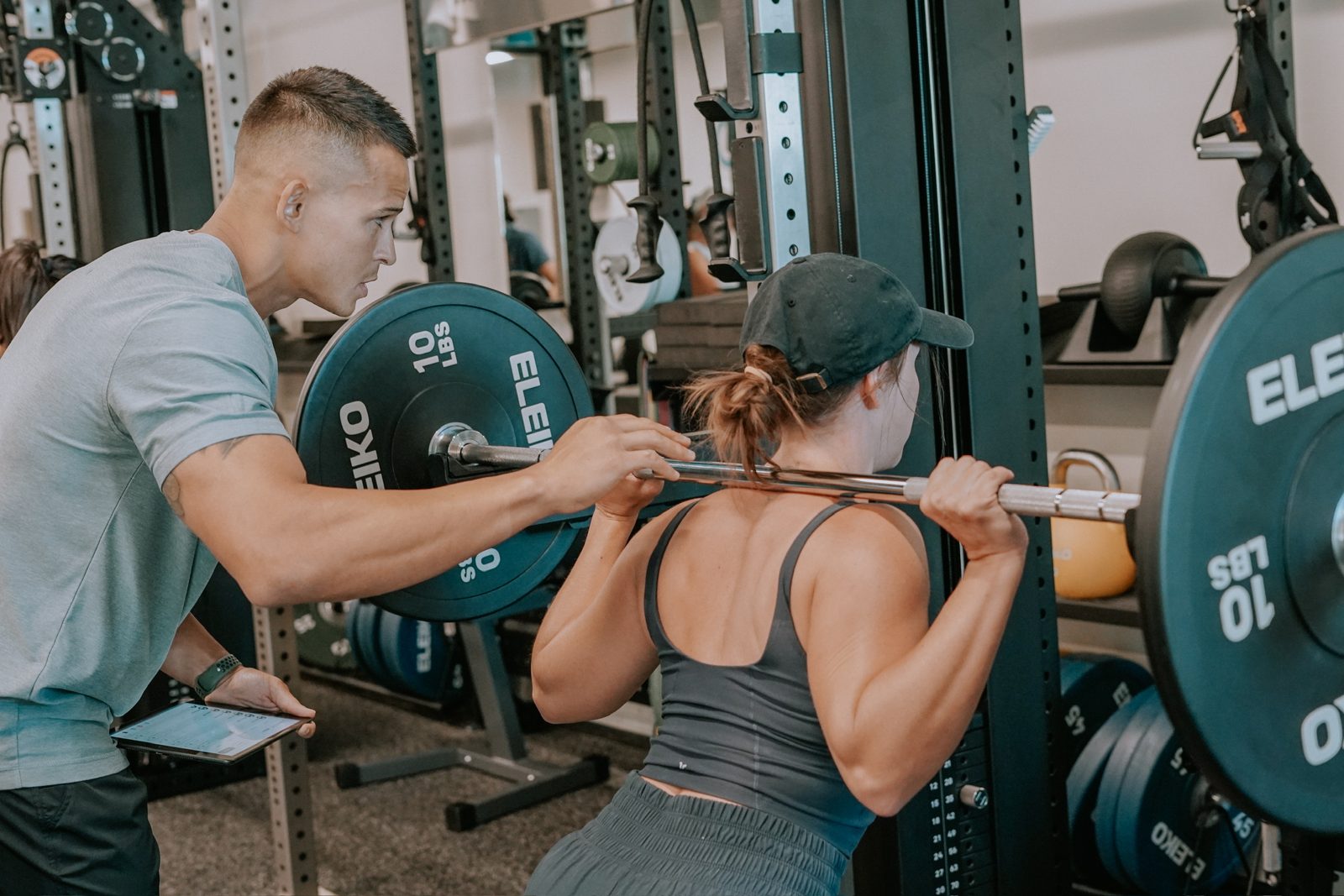
Early sessions should include demonstrations, practice and specific feedback. A coach might show you how to pick a weight up from the floor, sit into a squat or set up a pulling exercise. The version you use should reflect your current abilities.
For example, a squat might begin with sitting down to a bench and standing back up. A pushing exercise might use an elevated surface instead of the floor. These are useful exercise choices in their own right; you do not need to rush toward a harder-looking version.
Ask your coach:
- Where should I place my feet and hands?
- What should I focus on during this set?
- How demanding should the repetitions feel?
- What should I do if something feels uncomfortable?
You should be able to ask for another demonstration whenever you need one.
How heavy should a beginner lift?
There is no single starting weight for every beginner. It varies with the exercise, your experience and how you perform the movement that day. Your coach can help you find resistance that provides a useful challenge while allowing you to practice with control.
You do not need to test your maximum or finish every set unable to complete another repetition. The American College of Sports Medicine's 2026 guidance emphasizes consistent, individualized resistance training; complicated routines and training to momentary muscle failure are not required for the average healthy adult.
As you learn, your coach may adjust repetitions, resistance or the exercise itself. Our guide to progressive overload explains how those decisions support continued progress. Adding weight at every visit is not a requirement.
Build a routine you can repeat
Choose session times that work with your actual week, including work, family commitments and other activities. Ask your coach how often to attend initially and how to build a manageable routine.
At proof3, small-group training is limited to 12 people, often fewer. Coaches use your assessment information and adjust exercises and working weights within the session. Other members may have different goals and experience; their weights are not your target.
Keep a simple record of what you practice. Becoming more comfortable with equipment, needing fewer setup reminders and completing comparable exercises with better control are useful early observations. Review those alongside performance records with your coach.
Common questions before you start
Will coaching make strength training completely safe?
No exercise program can remove all risk. Clear instruction, appropriate exercise choices and gradual adjustments help you manage the demands. Tell your coach when something hurts or feels wrong rather than treating pain as a test of commitment.
Do I need to master every basic exercise first?
No. Your coach can select versions you can practice now and teach them during training. You do not need to arrive able to do a floor push-up, barbell squat or any other particular exercise.
What is the first step at proof3?
Contact the proof3 team to arrange your assessment and ask about preparation, current introductory options and scheduling. We are at 9220 East Vía de Ventura, Suite 121, in Scottsdale. Bring your questions and a sense of what you want training to help you do.
Live Stronger For Longer
Replace guesswork with data-driven strength and endurance training built around how your body actually moves.
No commitment. A coach will call you back — usually the same day.